
Temple University College of Public Health
Project Design Overview
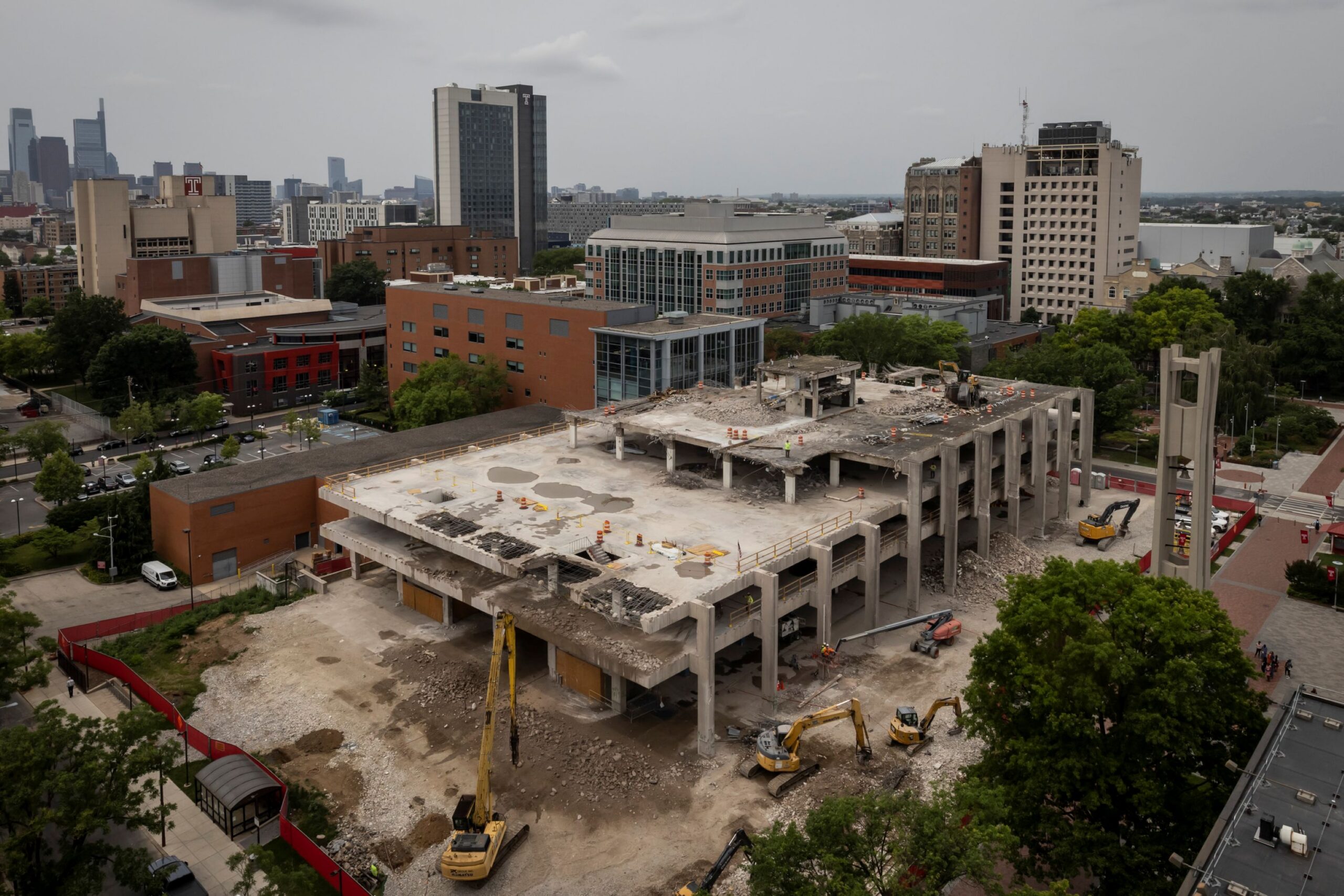
For years, Temple University’s College of Public Health had no shared home. Its programs were scattered across thirteen buildings on two separate campuses, leaving faculty across disciplines with no common identity and little easy way to collaborate. The opportunity to change that arrived in 2019, when the University’s original Paley Library closed following the opening of Charles Library, freeing up a windowless, three-story, 1960s brutalist structure at the heart of campus.
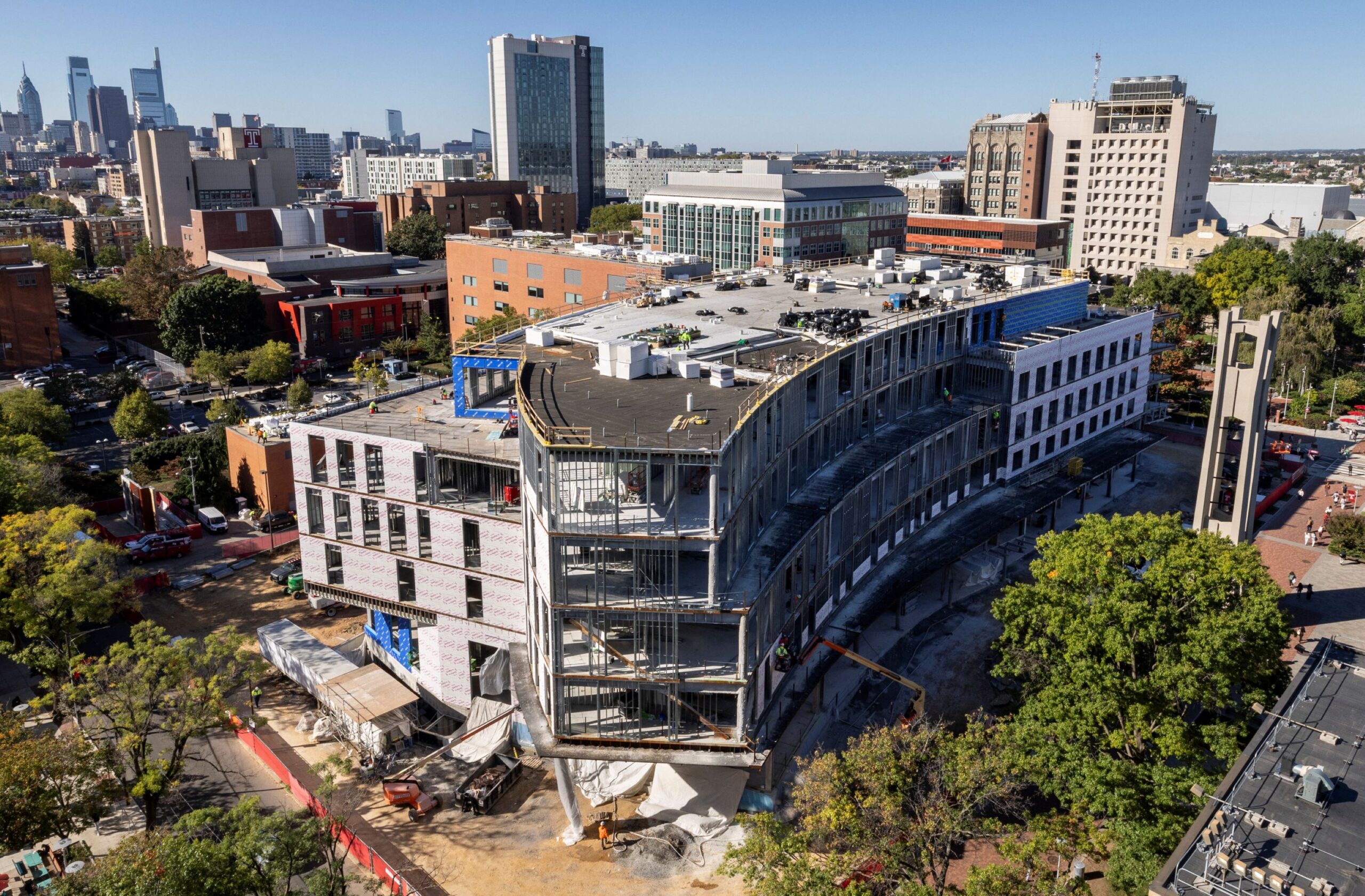
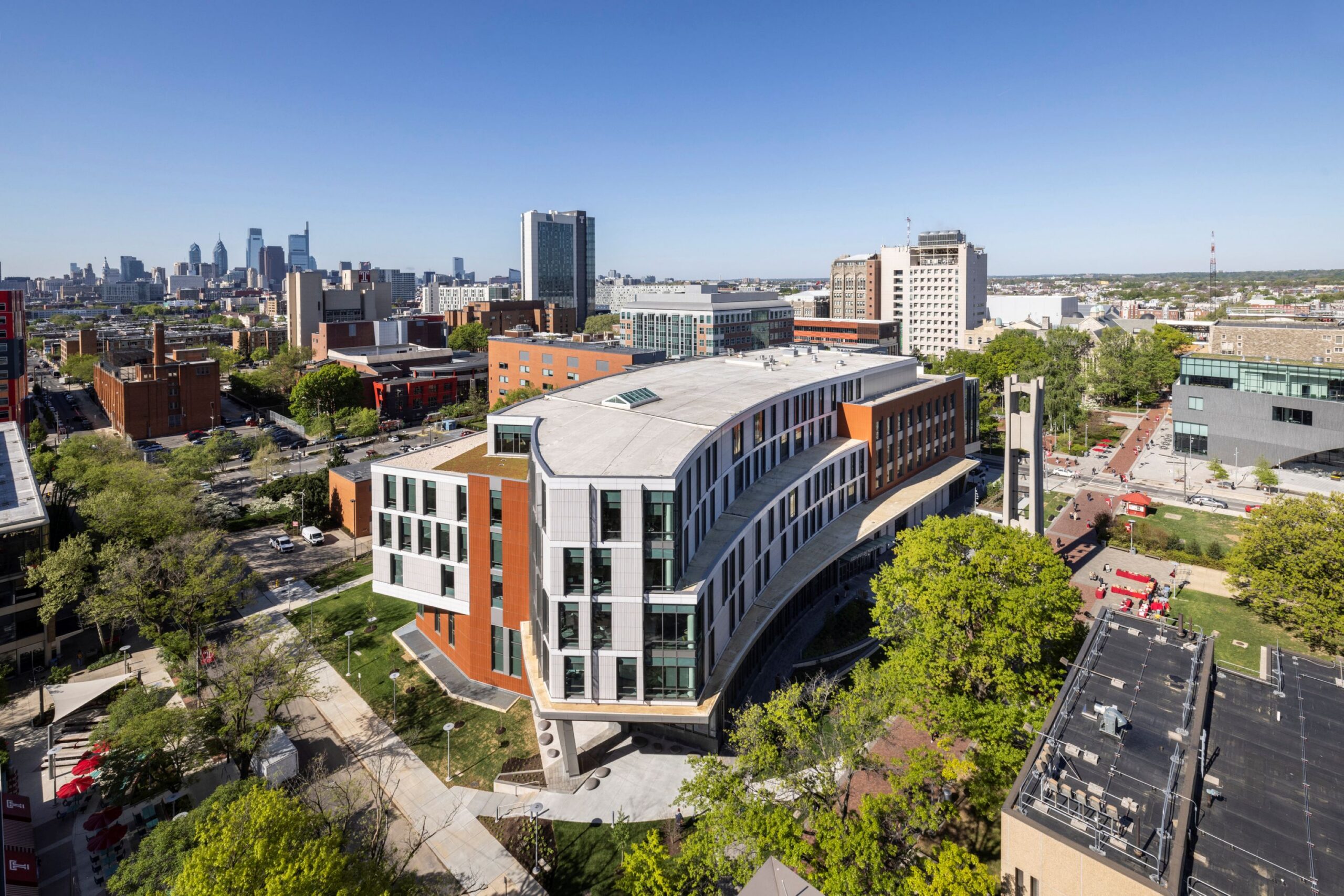
The design team’s strategy chose subtraction over demolition: retaining the existing structural frame to minimize lost embodied carbon. The team wrapped the North and East elevations in new additions, reclad the South and West in a lighter skin, and added two additional stories. Carving through structure and floor plates opened a daylit circulation spine running north to south with a monumental stair sequence choreographing movement through what is now the building’s architectural core.
The design consolidates the College’s programs under one roof for the first time in its history. Program elements include a multipurpose lobby, a wellness-focused mezzanine with a Zen Den and counseling suites, an immersive simulation center recreating clinical, home-based, and community-health environments, a nutrition lab, team-based-learning classrooms, research centers, and a relocated campus bookstore.
“This will be the first time in our college’s history that all our academic departments have been together under one roof; there are just so many inherent benefits that come with that.” – Jennifer Ibrahim, Dean of the College of Public Health
Completed in summer 2025, the 311,000-square-foot building achieved LEED and WELL Gold. The building’s grand opening became a landmark moment for the University and the wider community alike. Temple University President John Fry framed the opening in civic terms, describing a building that would help shape the leaders of tomorrow who will make communities healthier and safer.
Design Team:
Architect of Record: PZS Architects
Design Architect: The SLAM Collaborative
Structural Engineer: CVM
MEP Engineer: HF Lenz
Civil Engineer: Bohler Engineering
Landscape Architect: Ground Reconsidered
Lighting Designer: The Lighting Practice
Technology Consultant: Waveguide
LEED / WELL Consultant: Ecoworks
Cost Estimator: Becker & Frondorf




Project Scope
Discovery and Diagnosis
The design process began with an immersive discovery phase aimed at solving a core institutional challenge: the College’s disciplines were scattered across campus, both physically and culturally. Through visioning sessions with Temple University leadership and CPH faculty, we found that the real obstacle wasn’t a lack of space, but a lack of daily contact between departments. Our goal became a building that puts people from different disciplines in each other’s path. Using spatial mapping, we studied how students in nursing, social work, and therapy programs would naturally move through the building, then organized the design around the points where those paths should cross.
Collaborative Visioning and Interstitial Design
Rather than stacking departments floor by floor, we organized the building around a central Collaborative Spine, a methodology we call Functional Adjacency: placing complementary programs where students and faculty pass each other daily. The hardest problem was keeping specialized clinical labs technically rigorous while opening them up to public view. We answered it with glass-walled learning environments that put the science of public health on display, turning the spine into a sequence of spaces where cross-disciplinary conversations start by accident.
Iterative Modeling and Performance
On the technical side, an iterative modeling process addressed the demands of a tight urban site: how to balance high-occupancy thermal loads against the college’s desire for daylight everywhere. The answer was a high-performance envelope of masonry and glass, tuned through repeated facade studies to respond to solar orientation without sacrificing transparency. The result is a building that reads as thoroughly modern while still speaking to the university’s “Temple Made” identity, and one where a nursing student can glance across the spine and see a therapy session in progress, exactly the kind of collision the design was built to create.

A Building That Practices What It Teaches
The original building was a concrete box, engineered to keep sunlight out and books safe inside. Turning it into a home for public health education meant reversing that logic entirely, letting light and life pour into the center of the plan.
We kept the existing concrete frame, added three new floors, and wrapped the whole structure in a high-performance terracotta and glass skin. At the heart of the building, we carved an open core through the deep original floor plates, creating a vibrant central atrium that acts as a vertical town square. It’s the space that ties everything together, connecting specialized labs and clinical simulation suites to the informal, social life of the school.
Balancing those two worlds, clinical precision and everyday comfort, shaped every interior decision:
- Open sightlines. Glass partitions connect corridors to active learning labs, so the work of the college is always visible rather than hidden behind closed doors.
- Perch seating. Wide circulation paths are threaded with small, cushioned alcoves that turn hallways into informal study and gathering spots.
- Wood-slat ceilings. Natural materials bring acoustic control and organic warmth to high-volume common areas.
- Color-coded wayfinding. Cooler blues and greens mark quiet study zones, warmer tones mark social and dining hubs, helping people navigate a large, complex facility almost intuitively.
- Low-VOC, performance surfaces. Rubber flooring and stain-resistant textiles protect indoor air quality and support long-term health.
That commitment to wellness extends beyond materials. Large-scale glazing keeps a constant visual connection to the outdoors, flooding the atrium with diffused daylight and easing the stress that can come with a demanding clinical curriculum. As Temple’s first building to target WELL Gold, the project treats occupant well-being as a design driver, not an afterthought.
Sited on the campus’s busiest gathering plaza, the building’s transparent, active edges put public health on display, turning the architecture itself into an educational platform for healthy living. The result is an interior that feels distinctly Temple Made: resilient, transparent, and built to serve the community for decades to come.

Concrete Bunker to Light-Filled Landmark
“The Paley Hall project was a unique challenge, requiring us to transform a mostly windowless former library into a vibrant new academic hub. More than a renovation, it’s a complete reimagining of how the space serves students and faculty.”
Martin Droz, AVP of Planning, Design & Construction at Temple University

WE VIEW EACH PROJECT AS A UNIQUE CHALLENGE.
Learn more about our firm’s architecture, interior design, and master planning services by connecting with us.